IrriNex Logo
IrriNexIrrigation Solutions
Products
Solutions
DownloadsBlogAboutContact
Get Quote →
IrriNex Logo
IrriNexIrrigation Solutions

Specializing in drip irrigation, sprinkler systems, and smart water management. Reliable agricultural irrigation solutions from China for global farms.

+86 17300766401 info@irrinex.com WhatsApp

PRODUCTS

  • Drip Irrigation
  • Micro Irrigation
  • Irrigation Valves
  • Irrigation Filters
  • Irrigation Accessories

SOLUTIONS

  • Vegetable Drip Irrigation System
  • Orchard Dripper Irrigation System
  • Greenhouse Micro Sprinkler System
  • Greenhouse Drip Irrigation System
  • Fertigation System Solution

COMPANY

  • About Us
  • Contact

RESOURCES

  • Blog
  • Downloads
  • Sitemap
MATERIALS:PVC | CPVC | HDPE | PP | PPR | PPH | PVDF
STANDARDS:DIN | ANSI | BS | ISO 9001

© 2026 ZLONG LIMITED. All rights reserved.

Privacy PolicyTerms of ServiceShipping PolicySitemap
HomeProductsFertilizer InjectorVenturi Fertilizer Injector
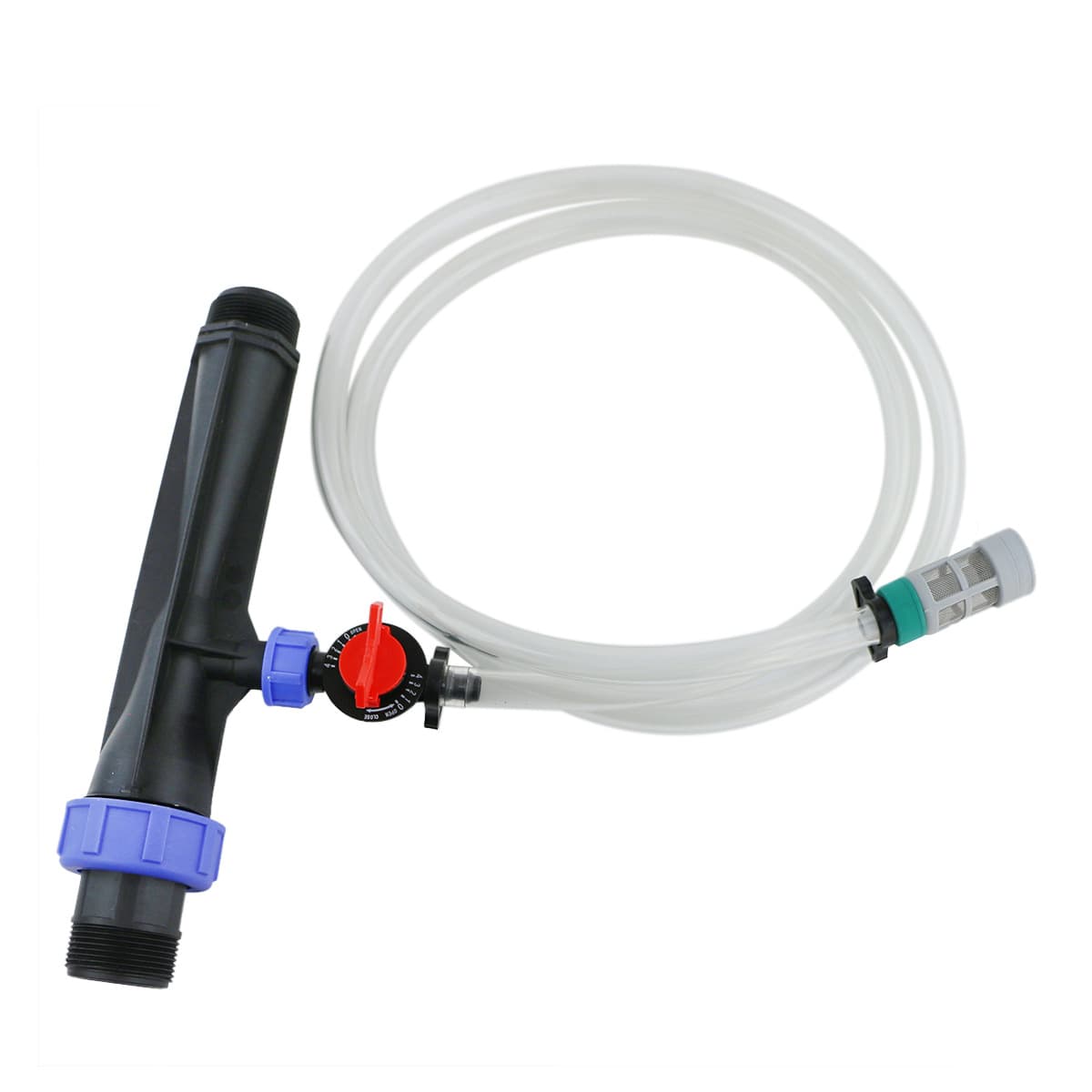
Venturi Fertilizer Injector - 11 / 6
Fertilizer Injector

Venturi Fertilizer Injector

SKU: FRT-VEN

No-power venturi injector for precise fertigation in drip and sprinkler irrigation systems.

Material

PP, PVC

Size Range

3/4" / 1" / 1-1/2" / 2"

Pressure

0.15 - 0.60 MPa

Standards

ISO

Applications

FertigationChemical injectionWater treatment

INQUIRY FOR:

Venturi Fertilizer Injector

Request a Quote

Technical Specifications

ParameterValue
Connection Size3/4" / 1" / 1-1/2" / 2"
Suction Rate40 - 500L/h
Operating Pressure0.15 - 0.60MPa
Differential Pressure≥ 30%

Full Description

Venturi Injector – IrriNex
how it works

The Venturi Effect in Practice

The operating principle is straightforward. Fluid entering the injector body accelerates as it passes through the narrowed throat section. Faster flow means lower local pressure — low enough to pull a second fluid through the side inlet without mechanical assistance.

What matters in practice is the pressure differential across the device. The inlet pressure needs to be measurably higher than the outlet pressure — typically 20 to 30% — to generate enough suction. On a flat mainline with a partially closed bypass valve this is achievable. If the pressure differential is too small, suction drops off and injection becomes inconsistent.

Unlike a proportional injector, the injection rate on a venturi isn't fixed — it varies with flow and pressure conditions. For crops where fertilizer concentration needs tight control, this is worth factoring in before you specify the product.

working sequence

What Happens Inside

1
Water enters the injector body
Full system pressure at the inlet. Flow is directed into the narrowing throat section.
2
Velocity rises, pressure drops
At the narrowest point of the throat, water velocity peaks and local pressure falls below atmospheric — the venturi effect.
3
Concentrate is drawn through the side inlet
The low-pressure zone pulls fertilizer solution from the concentrate tank through the suction port. No pump required.
4
Mixed solution exits into the mainline
The fertilizer-water mixture continues downstream through drip lines or sprinklers. Mixing continues along the lateral run.
materials

Available Materials

Material choice affects chemical compatibility, operating temperature range, and service life. The right call depends on what's going through the injector and how long it needs to last outdoors.

PP Polypropylene
Good resistance to acids, alkalis, and most fertilizer solutions. The default choice for standard irrigation and chemical dosing applications. Low cost and easy to source as a replacement.
Most common
PE Polyethylene
More flexible than PP and better at absorbing impact. Used where the injector body may be subject to knocks or rough handling. Suitable for water and non-corrosive liquid applications.
Impact resistant
PVC Polyvinyl Chloride
Rigid and pressure-rated higher than PP or PE. Handles corrosive inputs and higher-pressure systems. Less flexible, so it's better suited to fixed installations than portable setups.
High pressure
ABS Acrylonitrile Butadiene Styrene
Hard and impact-resistant. Used in air purification and industrial filtration where structural rigidity matters more than chemical resistance to aggressive liquids.
Industrial use
PA Nylon (Polyamide)
High tensile strength and abrasion resistance. Used where the injector body is under mechanical stress or where the fluid contains abrasive particles. Common in automotive and industrial lines.
High strength
installation

Installation Checklist

Most venturi problems come down to installation — wrong sizing, insufficient pressure differential, or no filtration on the suction line. These are the points that matter before you commission the system.

1
Size to your actual flow rate, not pipe diameter. An injector on an oversized mainline running at part-flow will under-inject. Match the injector's rated flow to the system's operating flow, not peak capacity.
2
Confirm the pressure differential. You need 20–30% pressure drop across the inlet and outlet ports to generate suction. A partially closed bypass valve creates this. Measure it — don't assume the system pressure is sufficient.
3
Follow the flow direction markings. The injector body is asymmetric. Installed backwards, it produces no suction and will show no obvious error other than nothing being drawn from the tank.
4
Put a screen filter on the suction inlet. The suction port is small. Sediment from the concentrate tank or undissolved fertilizer particles will block it. A simple inline strainer on the suction tube handles this.
5
Check material compatibility with the chemical being injected. PP handles most fertilizers. Concentrated acids, chlorine solutions, and some pesticide formulations need PVC or a specific resistant grade. Verify before filling the tank.
6
Seal all threaded connections properly. PTFE tape on male threads, torqued to hand-tight plus a quarter turn. A slow thread leak on the suction side introduces air and breaks suction before you find it.
7
Place the injector somewhere accessible. You will need to inspect the suction line, clean the strainer, and check connections periodically. Installing it inside a buried manifold box makes all of this harder than it needs to be.
8
Flush clean water through the system after each fertigation cycle. 5–10 minutes is usually enough to push residual fertilizer out of the laterals and emitters. Skipping this is the most common cause of emitter clogging over time.
9
Run a full-pressure test before leaving the site. Check every connection point for drips. Low-pressure weeps become high-pressure failures under field conditions.
10
Note the operating temperature range. PP and PVC have different upper limits. If the injector is installed in a location that gets hot — inside a greenhouse or under direct sun on a metal manifold — check that the material spec covers it.
Something not working after installation? The two most common causes are insufficient pressure differential (suction won't start) and a blocked strainer on the suction inlet (suction starts then stops). Check both before anything else.

Related Products

Proportional Fertilizer Injector
fertilizer injector

Proportional Fertilizer Injector

Water-driven proportional dosing injector for accurate fertilizer concentration control.

PP
Request Quote
Assembled Venturi Injector Set
fertilizer injector

Assembled Venturi Injector Set

Pre-assembled venturi injector set with bypass valves and fittings for easy installation.

PPPVC
Request Quote